


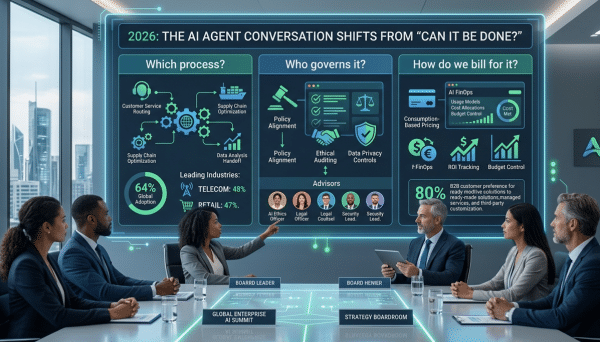
In 2026, the conversation around AI agents has shifted.
It’s no longer “can it be done?” It’s “which process, who governs it, and how do we bill for it?” NVIDIA’s survey of 3,200 enterprises globally found that 64% of organizations have already embedded AI into operational workflows, with telecom leading at 48% autonomous AI adoption and retail/consumer goods close behind at 47%. McKinsey’s B2B research reveals a key preference: roughly 80% of B2B customers prefer to acquire agentic AI through ready-made solutions, managed services, or third-party customization rather than building from scratch.
What does this mean for community healthcare and B2B industries? It means the real opportunity isn’t “building a smarter model” — it’s embedding agents into processes that already exist and letting them do the work.
Community Healthcare: Agents Are Moving Beyond “Pre-Visit Q&A”
Community health is undergoing a shift from “AI assistant” to “AI executor.”
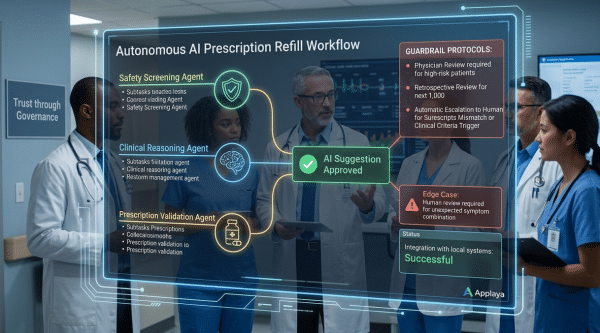
In January 2026, Utah launched the nation’s first autonomous AI prescription refill pilot, allowing AI agents to refill 192 medications for patients with chronic conditions. The design included explicit guardrails: the first 250 patients had every AI output reviewed by a physician, the next 1,000 were reviewed retrospectively; if a newer prescription existed in Surescripts, if the patient reported a medication-related problem, or if other clinical criteria were triggered, the system automatically escalated to human review.
This isn’t a proof of concept. It’s a multi-agent architecture deployed in a real clinical workflow: a safety screening agent, a clinical reasoning agent, and a prescription validation agent each handling a discrete subtask, with an orchestration layer managing context and handoffs. A Lancet survey of 28 NGOs across 18 countries found that 61% are piloting AI solutions, but only 4% have achieved meaningful integration with local public health systems. Where’s the gap? Not in model capability — in governance, data interoperability, and frontline workflow fit.
The real bottleneck for agent deployment in community health isn’t “can it answer?” It’s “do we trust it to act?”
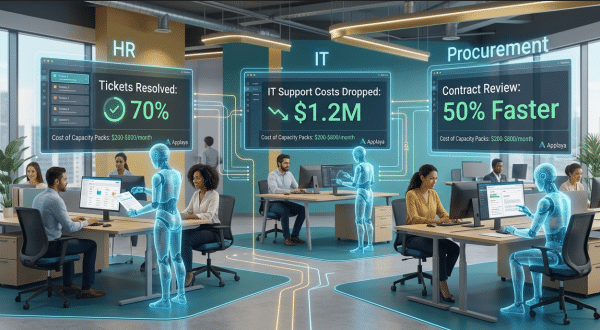
B2B Process Automation: From IT Tickets to Procurement Contracts
If the keyword for healthcare agents is “safety,” the keyword for B2B is “efficiency recovery.”
Real deployment data from EPC Group paints a clear ROI curve:
A 1,500-person mid-sized healthcare company deployed a HIPAA-compliant HR agent. Within 90 days, HR tickets dropped 70%, resolution time for escalated tickets fell 40%, at a cost of $200/month in capacity packs.
A Fortune 100 financial services firm deployed an IT agent covering 18,000 employees. L1 ticket auto-resolution hit 60%, annual support costs dropped $1.2M, at $800/month.
A Fortune 500 manufacturer deployed a procurement agent covering 8,500 employees across 22 plants. Procurement helpdesk volume dropped 50%, with contract Q&A and supplier queries significantly accelerated, at $400/month.
What do these numbers have in common? Agents didn’t replace anyone — they freed humans from repetitive information retrieval and process coordination. Copilot Studio’s three harness designs map directly to this layered need: the standard harness handles predictable, rule-based conversations (like ticket routing), the GitHub Copilot harness handles multi-step reasoning workflows (like contract review), and the Copilot chat harness connects enterprise knowledge into the M365 Copilot employees already use daily.
What Applaya Does: From “Picking the Right Agent” to “Governing It Well”
Deploying an agent isn’t buying software and “going live.”
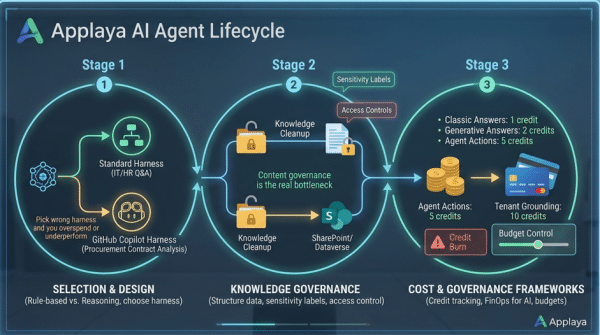
EPC Group’s standard delivery timeline shows: for organizations with clean knowledge sources, a department-level agent takes 8–12 weeks from kickoff to production; for organizations needing content cleanup and governance, that stretches to 16–26 weeks — content governance is the real bottleneck.
This is where Applaya comes in.
Our services cover three stages of the agent lifecycle:
Selection and design. Not every process needs an autonomous agent. Rule-based agents on the standard harness are cheaper and more predictable — ideal for IT helpdesks and HR policy Q&A. Reasoning agents on the GitHub Copilot harness suit procurement contract analysis and multi-step approval flows. Pick the wrong harness and you either overspend on intelligence you don’t need, or force a rules engine to handle tasks that require judgment.
Knowledge source governance and deployment. An agent’s answer quality is determined by its grounding data. We help organizations structure knowledge across SharePoint, Dataverse, and business systems, apply sensitivity labels and access controls, and ensure agent responses are both accurate and within bounds.
Cost and governance frameworks. Copilot Studio’s credit-based billing model requires design thinking: classic answers cost 1 credit each, generative answers 2 credits, agent actions 5 credits, and Graph tenant grounding 10 credits per query. A ten-turn tenant-data conversation can burn through 100+ credits. We help clients build usage models before deployment and set budgets and model access policies under the FinOps for AI framework — so agents don’t run so well that the bill runs away.
Where to Start
A community health agent can start small: not prescription refills, but pre-visit intake information collection and safety screening — AI gathers symptom summaries, flags urgent cases, and hands structured information to clinicians. B2B starts just as concretely: an HR Q&A agent on a SharePoint knowledge base, a procurement contract query agent in Teams.
We don’t do vague “AI transformation” talk. We do this: find one repetitive process that eats hours of your team’s week, hand it to the right agent, set the guardrails, manage the cost, and keep it running.
If your organization is evaluating its first agent use case, or you’ve already built a prototype in Copilot Studio but are stuck on knowledge governance or cost modeling, let’s talk.

